Solanica Platform
OpenEverest,
hardened for production.
The enterprise distribution of OpenEverest: the same open source control plane, plus 24/7 support, custom engineering, and the team that built it. Run databases, AI, and object storage across any Kubernetes fleet, inside your own perimeter.
Everything you need on day 2
Creating a database is the easy part. Solanica Platform gives your team the tools to watch, protect, and secure it for years, from the same console for every technology.
Observability
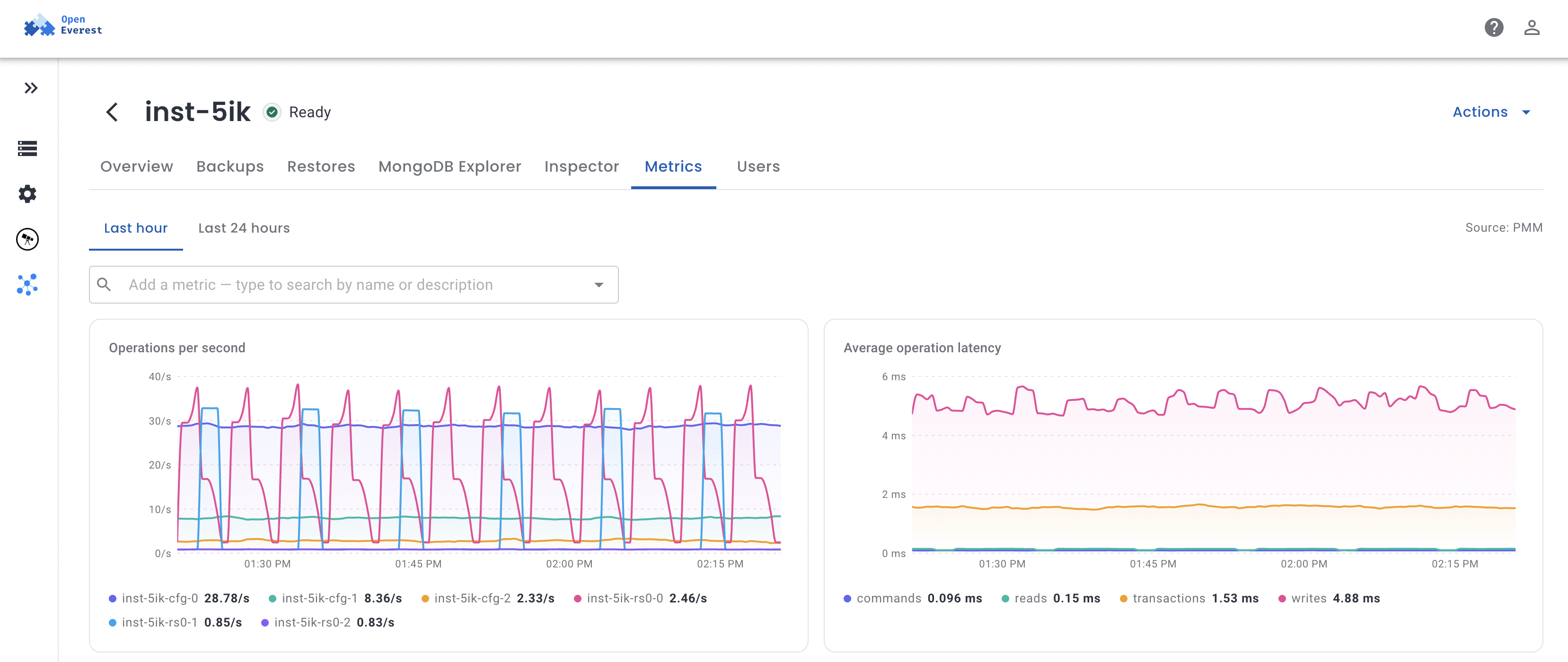
See what every instance is doing
Metrics, pods, and logs live next to the instance and feed your existing monitoring, rather than locking you into one tool.
- Prometheus exporters and a managed PodMonitor, ready for the Prometheus and Grafana you already run
- Percona Monitoring and Management (PMM) with query analytics for Percona-based providers, and OpenTelemetry tracing for LLM serving
- A pluggable monitoring layer, so metrics can flow into whatever pipeline fits your stack
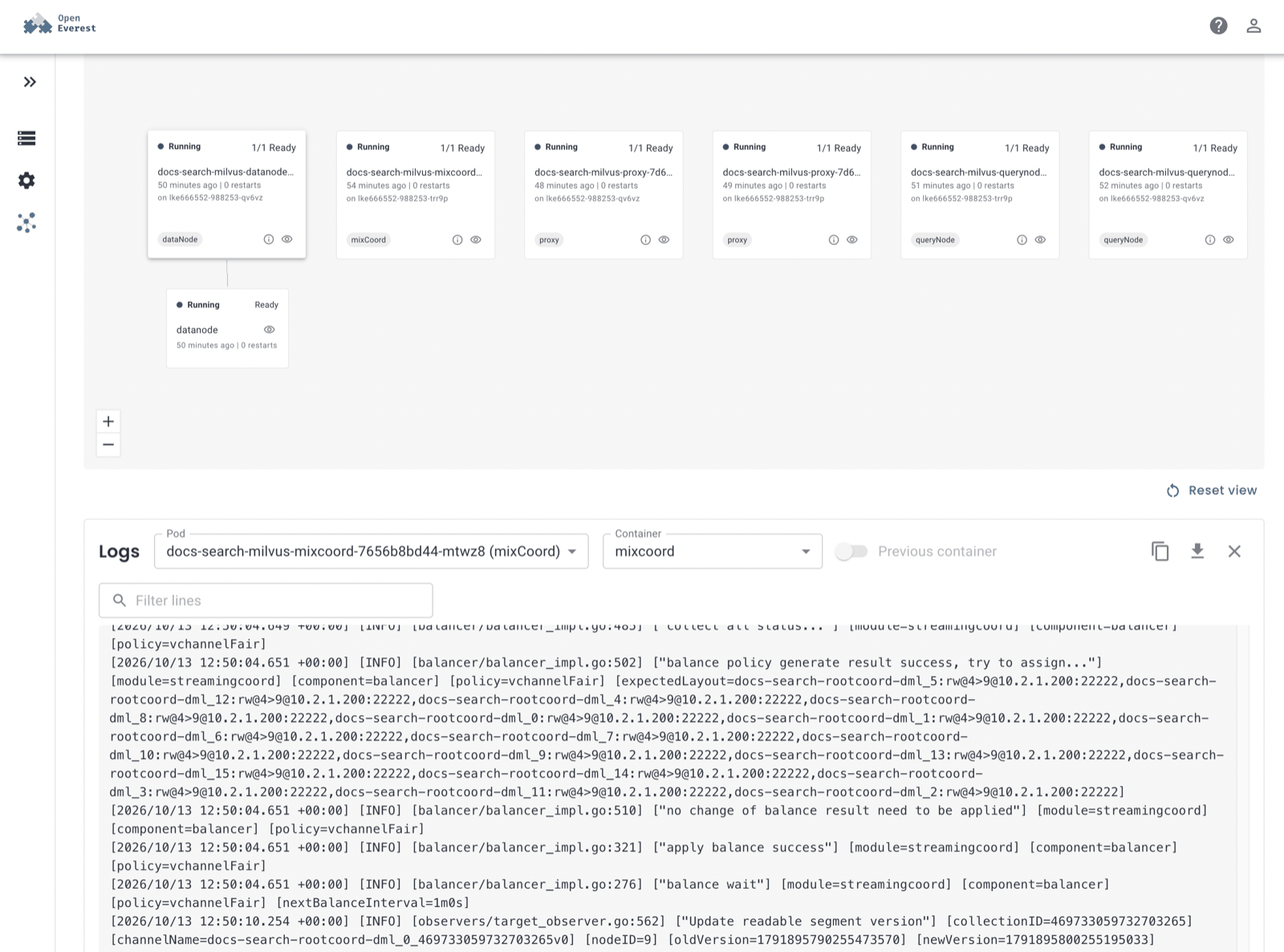
- The Inspector maps every component, pod, and node with its status and restarts
- Container logs per pod, with filtering, copy, and download
Data protection
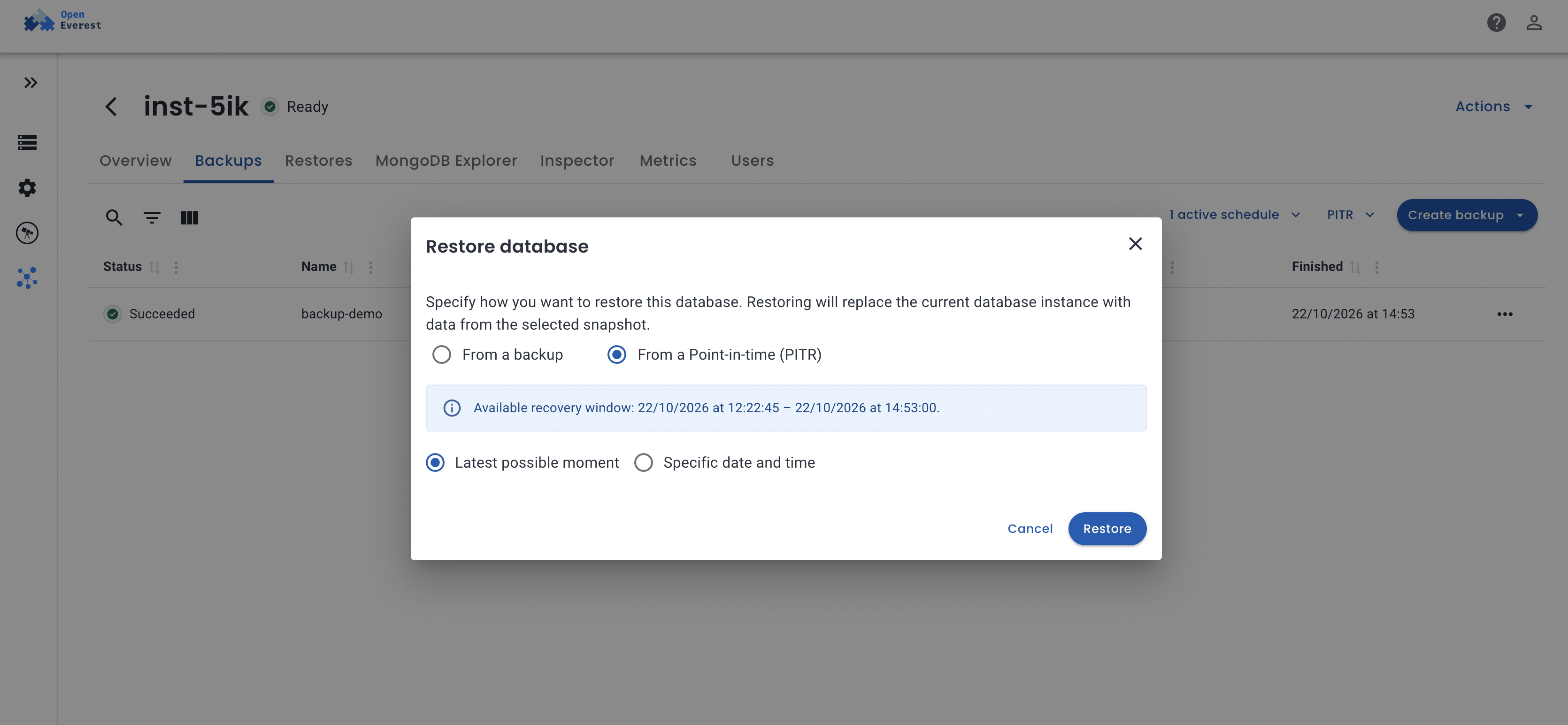
Backups and point-in-time recovery
Backups and restores follow the same workflow across technologies, so your team learns it once.
- On-demand and scheduled backups with retention
- Stored in your own S3-compatible bucket
- Restore to any second within the recovery window
- Spin up a new instance from a backup for staging or forensics
Access control
RBAC, SSO, and database users
Decide who can create, change, and see what, then hand applications only the credentials they need.
- RBAC policies per namespace and resource
- Single sign-on over OIDC, with roles mapped to IdP groups
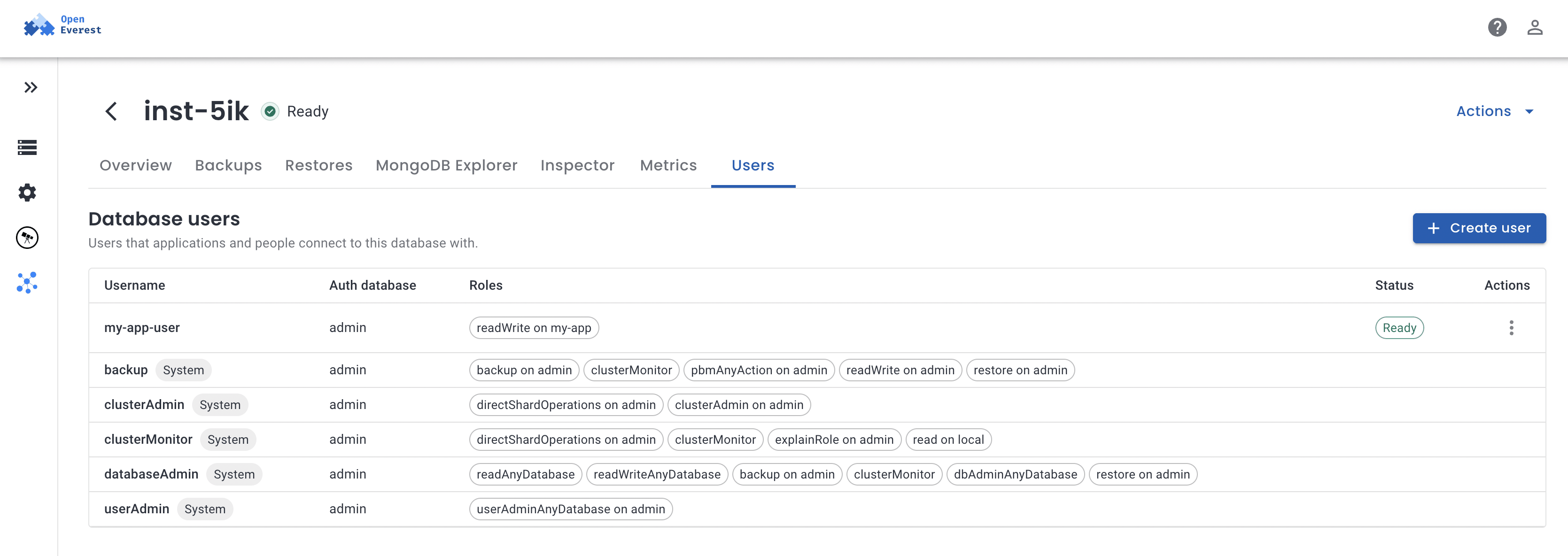
- Database users and roles managed from the console
- TLS for client and internal connections
Upgrades that ask before they disrupt
Upgrading an operator shouldn't be an act of faith. OpenEverest holds back any change that would restart or stop an instance until someone approves it.
- You set the tolerance. Each instance declares how much disruption it accepts automatically: none, a rolling restart, or downtime.
- Everything else waits. Pending actions are listed on the instance and run only after you approve that specific action.
- Upgrades are checked first. A provider upgrade that would strand an instance on a removed version is blocked before it starts, and deprecated versions are flagged early.
- Failures stop. An approved action that keeps failing trips a circuit breaker instead of looping on a live database.
spec:
  maintenance:
    # NonDisruptive | RollingRestart | Downtime
    autoApproveUpTo: NonDisruptive
status:
  pendingMaintenance:
    - description: Restart the replica set one node
        at a time to adopt the new operator's pod template
      severity: RollingRestart
Built for platform teams
The building blocks for a self-service data platform that stays under control.
Golden paths with presets
Package a vetted instance shape once. Developers pick a preset, name the instance, and press Create.
Suspend idle databases
Stop the pods of dev and test instances overnight while keeping storage, credentials, and backups.
Placement policies
Spread replicas across nodes and zones by default, with node selectors, tolerations, and topology spread when you need them.
One API for everything
The web UI, REST API, CLI, and Kubernetes resources all drive the same Instance objects. Use whichever fits the workflow.
Auditable event stream
Subscribe to every change through the events API, with replay after reconnects, to feed audit logs and automation.
Extend with plugins
Add new technologies with the Provider SDK, or new screens and tools to the console with generic plugins.
Your data never leaves your perimeter
Solanica Platform installs into your Kubernetes clusters. We provide the control plane; you keep the data, the backups, and the keys.
Any Kubernetes
EKS, GKE, AKS, on-prem distributions, or bare metal. The same UI and API everywhere.
Air-gapped ready
Run in disconnected environments with no external dependencies.
Your storage
Data stays on your persistent volumes, and backups go to your own bucket.
No egress
Queries, metrics, and model traffic stay inside your network.
One control plane, three patterns
One product you can put to work in three different ways. Pick the one that matches your team.
For operations teams
Private DBaaS
Replace RDS, Atlas, and Cloud SQL with a private DBaaS on your own Kubernetes.
- Relational, document, analytics, and caching engines
- High availability and PITR
- Predictable infrastructure cost
For AI architects
AI infrastructure
Run the stateful side of AI next to your data, on your own GPUs.
- Milvus for vector search and RAG
- LLM serving with KServe and vLLM
- OpenAI-compatible endpoint with per-model keys and token quotas
For platform engineers
Internal developer platform
Close the stateful gap in your IDP without losing governance.
- Self-service through the API or GitOps
- Presets as golden paths
- RBAC per team and namespace
One engine, two ways to run it
OpenEverest is the open source core any team can adopt. Solanica Platform adds vendor-grade support and engineering on top, on the same code path, so moving between them needs no migration.
Open source
OpenEverest
- Apache 2.0, free to deploy, modify, and run
- CNCF Sandbox project with vendor-neutral governance
- Databases, AI, and object storage through open source providers
- Web UI, REST API, and Kubernetes resources, the same as the enterprise tier
- Community support on GitHub, Slack, and public docs
Enterprise distribution
Solanica Platform
- 24/7 production support with SLA, from the engineers who wrote the code
- Microsoft SQL Server provider with Always-On Availability Groups
- Custom providers for the engines and integrations you need
- Design partnership with architecture reviews and hands-on deployment
- Long-term security patches and hardened release channels
Design partner program
We don't just license software. We sit with your team.
Your infrastructure has edge cases, and we have the engineers who wrote OpenEverest. When a legacy database, a niche accelerator, or a custom integration blocks your migration, we build it into the platform as part of the engagement.
Custom providers
Bring engines and legacy data sources such as Oracle or mainframe systems into the same console.
Hardware acceleration
Tune for AWS Trainium, Google TPUs, or custom accelerator setups.
Direct access
Skip tier-1 support with a shared Slack channel to the engineers who wrote OpenEverest.
Ready to ship?
Stop building infrastructure. Start shipping.
Your team shouldn't have to think about the plumbing behind databases and AI. Give them a platform that handles it.