Solanica vs Altinity.Cloud
Altinity.Cloud is a managed ClickHouse service that can run in Altinity's cloud, in your cloud account, or on your own Kubernetes, operated by Altinity. Solanica, built on the open source OpenEverest project, gives you an open source control plane for ClickHouse and other databases on Kubernetes in your own account: either your existing clusters, or a cluster Solanica deploys and manages for you.
Both use the same open source engine underneath: the Altinity Kubernetes Operator for ClickHouse. The difference is who owns the control plane and day-2 operations. Altinity.Cloud is an established managed service; ClickHouse in OpenEverest is newer, and available through early access.
Altinity.Cloud
Managed ClickHouse from ClickHouse specialists, now part of EDB.
- Production-ready, with backups, DR and 24/7 support
- Runs in Altinity's cloud, your cloud account, or your Kubernetes
- Managed through the hosted Altinity Cloud Manager
- Priced per vCPU in your own cloud
Solanica + OpenEverest
An open source control plane for many databases, in your cluster.
- Control plane runs in your cluster, licensed under Apache 2.0
- ClickHouse next to PostgreSQL, MySQL, MongoDB and more
- No per-vCPU management fee
- ClickHouse available through early access
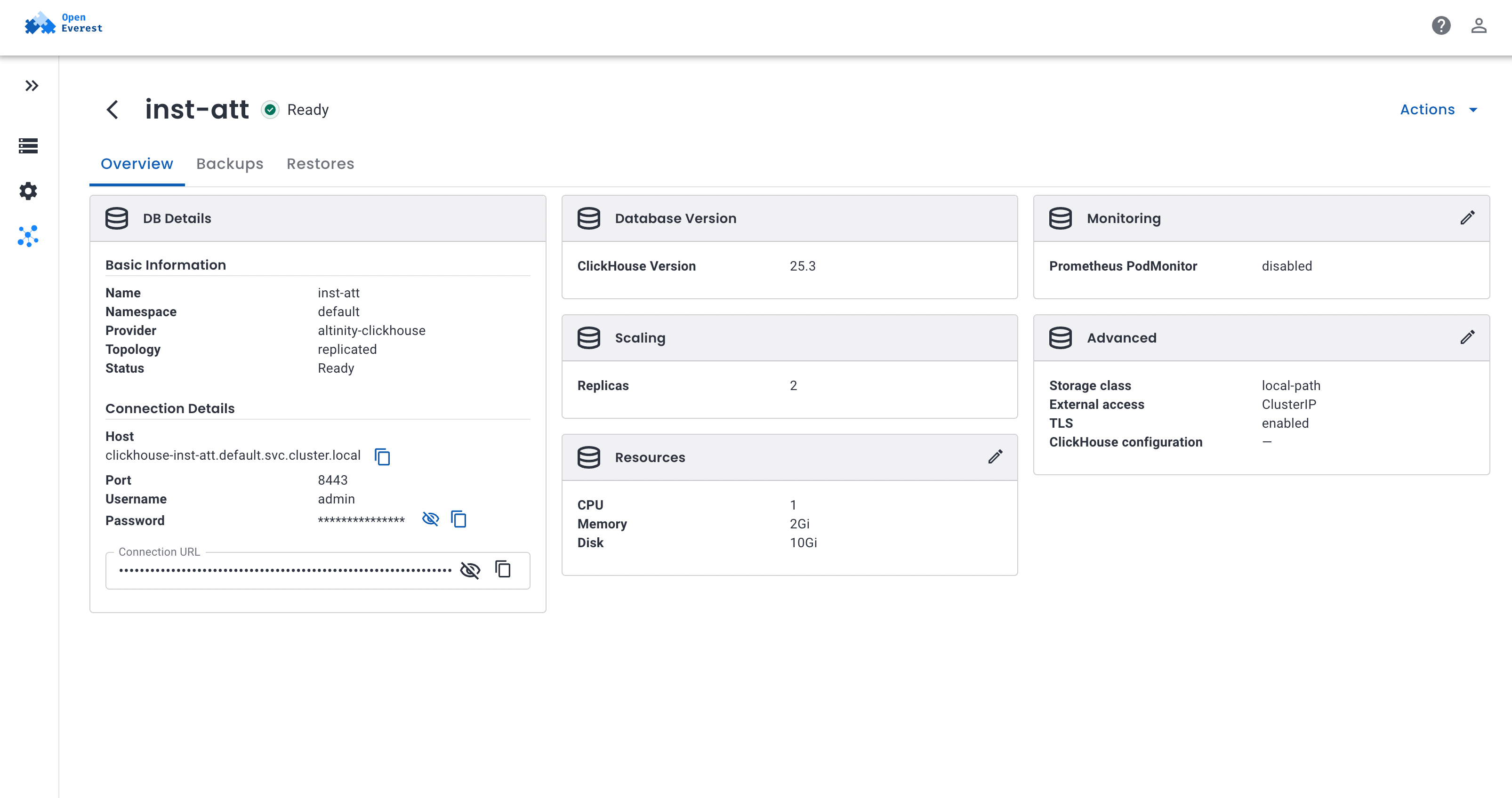
Side by side
| Solanica + OpenEverest | Altinity.Cloud | |
|---|---|---|
| Deployment and control | ||
| Where ClickHouse runs | Kubernetes in your own account: your existing EKS, GKE, AKS, RKE2, K3s or bare-metal cluster, or a cluster Solanica deploys and manages in your cloud account | Altinity's cloud account, your cloud account (AWS, GCP, Azure, Hetzner, Nirvana), or your own Kubernetes |
| Control plane | OpenEverest runs inside your cluster. It is open source, and nothing reports to a vendor | The Altinity Cloud Manager is hosted by Altinity. In your own Kubernetes, it connects through an outbound, certificate-secured HTTPS link |
| Air-gapped environments | Supported. Normal operation needs no connection to external endpoints | Managed operations need the Altinity Cloud Manager connection. You can disconnect, and then you run ClickHouse yourself |
| Kubernetes operator | Altinity Kubernetes Operator for ClickHouse (Apache 2.0) | Altinity Kubernetes Operator for ClickHouse (Apache 2.0) |
| ClickHouse maturity | ||
| Track record | Runs on the battle-tested Altinity operator. The OpenEverest ClickHouse integration is new and available through early access | Established managed service with SOC 2 Type 2 certification and customers such as The Trade Desk and PostHog |
| Backups and disaster recovery | Managed backups, restore and point-in-time recovery are next on the roadmap | Managed by Altinity, including disaster recovery |
| Topologies | Standalone, or replicated with ClickHouse Keeper and sharding. Shards can be added but not removed | Replicated and sharded clusters, managed by Altinity |
| ClickHouse builds | ClickHouse LTS releases (26.8 and 26.3 today), or your own image | Any open source compatible ClickHouse, including Altinity Stable and Antalya builds |
| Pricing | ||
| Pricing model | OpenEverest is free. You pay your cloud provider directly. Solanica support for ClickHouse is priced in early access, with no per-vCPU markup | Per vCPU in your own cloud: $45, $60, or $80 a month (Dev, Enterprise, Premium). Storage is free. Your cloud bill is separate |
| Example: 48 vCPUs | Your infrastructure cost, plus a Solanica plan if you want one | $2,160–$3,840 a month in management fees at list price, plus infrastructure |
| Platform scope | ||
| Other databases | PostgreSQL, MySQL, MongoDB, Valkey, ClickHouse and more in one console and API. SQL Server through Solanica | ClickHouse. EDB plans to integrate it with Postgres in EDB Postgres AI |
| Licensing | OpenEverest and its bundled operators are open source. Solanica adds some proprietary plugins, such as SQL Server | ClickHouse, Altinity Stable Builds and the operator are Apache 2.0. The Altinity Cloud Manager is proprietary |
| Ownership | OpenEverest is a CNCF Sandbox project. Solanica is its commercial sponsor | Part of EDB since November 2026, as the EDB Real-Time Analytics group |
| Support | ||
| ClickHouse expertise | Kubernetes and multi-database operations. ClickHouse-specific support is new | Altinity describes itself as the second-largest contributor to ClickHouse, and it created the operator |
| Support model | Direct Slack with OpenEverest engineers through early access | 24/7 on Enterprise and Premium, with 4-hour and 1-hour P1 SLAs |
A highlighted cell marks the clearly stronger option for that row. Altinity.Cloud details come from Altinity's public website and documentation as of November 24, 2026.
The same operator, a different control plane
Altinity created the first Kubernetes operator for ClickHouse, and it is the engine under both products. Altinity.Cloud adds the Altinity Cloud Manager on top: a hosted control plane, plus a team of ClickHouse specialists who handle provisioning, upgrades, backups, monitoring and incidents for you.
OpenEverest wraps the same operator in a technology-agnostic API and UI that runs inside your cluster, next to the providers for PostgreSQL, MySQL, MongoDB and other engines. Nothing phones home. You choose who runs the Kubernetes underneath: your platform team on your existing clusters, or Solanica on an opinionated cluster we deploy and manage in your cloud account.
What changed with EDB
On November 5, 2026, EDB announced it had acquired Altinity. Altinity's CEO says contracts, SLAs, products and the management team are unchanged. EDB has committed publicly to keeping the operator, Altinity Stable Builds and ClickHouse under Apache 2.0, and to keeping Altinity.Cloud customers' service, SLAs and deployments. The stated roadmap puts ClickHouse alongside Postgres in EDB Postgres AI, with a shared Apache Iceberg catalog and consistent access controls.
For many Altinity.Cloud customers, that's good news or no news. If you're re-assessing anyway, our Altinity.Cloud alternatives roundup covers ClickHouse Cloud, Instaclustr, Aiven, Tinybird and self-managed options.
| Operation | Solanica | Altinity.Cloud |
|---|---|---|
| Who handles incidents | Your team, with Solanica engineers available through early access | Altinity's support team, 24/7 on Enterprise and Premium |
| Backups | Managed backups are on the roadmap. Until then, ClickHouse BACKUP or clickhouse-backup work alongside OpenEverest | Managed backups and disaster recovery |
| Configuration | ClickHouse server settings through the Instance API | Through the Altinity Cloud Manager |
| Infrastructure as code | Kubernetes custom resources, Helm, and GitOps, all inside your cluster | Managed by Altinity through the Altinity Cloud Manager |
| Monitoring | Built-in metrics endpoint, sent to the destination you choose | Managed monitoring and alerting from Altinity |
When Altinity.Cloud is the better choice
You want fully managed backups and a 24/7 SLA today
Altinity.Cloud includes managed backups, disaster recovery and round-the-clock support today. In OpenEverest, managed ClickHouse backups are next on the roadmap.
You want someone else to run ClickHouse
Altinity's team handles scaling, upgrades and incidents, with the depth of a team that has contributed to ClickHouse for years and wrote its Kubernetes operator. If your team doesn't want to be on call for ClickHouse, that's worth the per-vCPU fee.
You're heading toward EDB Postgres AI
If you already run EDB Postgres and want one vendor for transactional and analytical data, the combined EDB and Altinity roadmap is built for you.
When Solanica is the better choice
You don't want a vendor control plane
Air-gapped sites, strict sovereignty rules or a simple policy of "nothing phones home" all point to a control plane that lives in your own cluster and is open source end to end.
ClickHouse is one of many databases you run
If your platform team also runs PostgreSQL, MySQL, MongoDB or Valkey on Kubernetes, one open source control plane for all of them is simpler than a separate managed service per engine.
Per-vCPU fees are adding up
At list price, a 48-vCPU footprint is $2,160 to $3,840 a month in management fees before infrastructure. Teams that already operate Kubernetes may prefer to put that money into their own platform.
You want to shape the roadmap
ClickHouse in OpenEverest is in early access. Partners help decide what we build next, starting with managed backups and restore.
Moving from Altinity.Cloud
Altinity makes leaving straightforward: if you disconnect a bring-your-own-cloud environment from the Altinity Cloud Manager, your ClickHouse cluster keeps running and you take over operations. To move data into a new OpenEverest-managed cluster, use ClickHouse's own tools: BACKUP and RESTORE through S3, clickhouse-backup, or INSERT INTO ... SELECT FROM remote() for a table-by-table copy.
- No data passes through Solanica servers.
- Run both side by side until you trust the new cluster.
- Start with a staging environment and promote to production once you're confident.
Altinity and Altinity.Cloud are trademarks of Altinity, Inc. EDB and EDB Postgres AI are trademarks of EnterpriseDB Corporation. ClickHouse is a registered trademark of ClickHouse, Inc. PostgreSQL, MySQL, MongoDB, Valkey and other product names are trademarks of their respective owners. Solanica and OpenEverest are not affiliated with or endorsed by Altinity, EDB, or ClickHouse, Inc., and these names are used here only to identify the products being compared. Altinity.Cloud details are based on publicly available information as of November 24, 2026.